Happy Birthday Paper: Your Go-To Digital Background for Real Creative Work
Happy Birthday Paper isn’t just another themed graphic—it’s a practical, high-resolution toolkit designed for people who make things. Whether you’re designing a birthday card for your niece, prepping a client’s social media campaign, or assembling a memory book for your child’s first birthday, these 16 JPEG files deliver consistent quality and real-world flexibility.
What You’re Actually Getting (and Why It Matters)
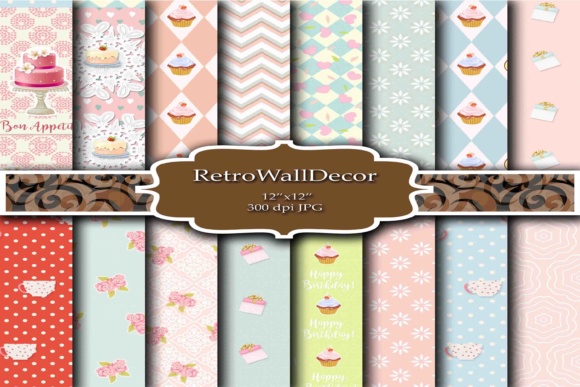
Each file is a 12 x 12 inch, 300 dpi, 3600x3600 px JPEG—optimized for print and digital use without pixelation or scaling headaches. The palette leans into soft, joyful tones: think pink and light blue cupcake motifs, delicate sprinkles, subtle fondant textures, and gentle watercolor-style backgrounds. No loud gradients or overdesigned elements—just clean, versatile surfaces that let your photos, text, or embellishments take center stage.
This isn’t clipart. It’s background-grade design: balanced contrast, neutral white space, and intentional negative space so text stays legible and layered elements feel intentional—not cluttered.
Where It Fits Into Real Projects (Not Just “Scrapbooking”)
People reach for Happy Birthday Paper when they need something reliable, fast, and print-ready—without hiring a designer or wrestling with templates.
- Small business owners use the pink and light blue cupcake backgrounds to build cohesive Instagram story series for bakery promotions, baby shower packages, or local event flyers. One user printed six of the files as 5x7 flat cards for a pop-up market—no extra editing needed.
- Educators and homeschoolers layer student artwork onto the happy birthday paper backgrounds before printing class birthday banners or classroom door decorations. The consistent size means everything lines up on bulletin boards—even when printed across different devices.
- Freelance designers keep these files in their “quick-start” folder for client projects where brand colors are still in flux. They drop in a logo or name, adjust opacity slightly, and send three clean options in under 15 minutes.
- Hobbyists building physical scrapbooks print directly onto cardstock or photo paper, then cut and layer with vellum, ribbon, or pressed flowers. The 300 dpi resolution holds up beautifully next to real textures—not just on screen.
How It Solves Everyday Creative Friction
We’ve all been there: staring at a blank document, trying to match a font color to a background that’s *almost* right—or spending 45 minutes adjusting brightness on a free download only to find it’s 72 dpi and looks blurry when printed.
Happy Birthday Paper cuts through that. Because all 16 files share the same dimensions, resolution, and color profile, you can mix and match confidently. Use one for a card front, another for the back, and a third as a digital overlay in Canva or Photoshop—all without resizing, resampling, or color-shift surprises.
That consistency matters whether you're batch-printing 30 party invites or designing a single digital greeting for a remote team member’s milestone birthday.
Use Cases That Go Beyond the Obvious
It’s easy to assume “happy birthday paper” only belongs in celebration contexts—but users regularly repurpose these files in smart, low-effort ways:
- Classroom planners: Teachers use the light blue cupcake background as a cheerful header for weekly behavior charts or reading logs—soft enough to stay functional, warm enough to feel encouraging.
- Digital newsletters: Bloggers insert the pink cupcake background behind short birthday-themed tips (“5 Ways to Make Virtual Birthdays Feel Special”)—then export as a single-image email header that loads instantly on mobile.
- Product packaging mockups: Etsy sellers photograph handmade candles or cookies against printed Happy Birthday Paper backgrounds to show how their items might look styled in real life—no studio lighting required.
- Therapy and special education tools: Some clinicians print simplified versions (cropped to focus on texture or shape) to support sensory exploration or visual sequencing activities with children.
What to Consider Before You Download or Buy
These files shine when you need polished, ready-to-use assets—not raw design elements. If you’re planning heavy photo manipulation (like complex masking or blending modes), check the JPEG compression level first: while optimized for clarity, they’re not layered PSDs. For deep customization, you’ll want to pair them with simple editing tools like Photopea or Affinity Photo—not just mobile apps with limited export control.
Also consider your output method. If you plan to print at home, test one file on your printer first—especially if using glossy or matte cardstock. Some inkjet printers add slight warmth; laser printers may mute pastels. A quick test print saves time later.
And remember: resolution isn’t everything. These files are sized for 12x12 physical output—but if you’re designing for web-only use (like social posts or email headers), you can safely scale down to 1920x1080 or smaller without losing impact. Don’t overcomplicate it.
Who Benefits Most—and How They Use It Differently
A freelance marketer might use the cupcake digital background for scrapbooking as part of a larger brand kit—dropping in client logos and reusing the same base across multiple campaigns. A grandparent making a memory book uses the same file differently: printing it full-bleed, trimming by hand, and gluing it beside photos with a glue stick—not worrying about bleed zones or CMYK conversion.
An educator downloads all 16 files not to use them all at once, but to rotate visuals across months—keeping birthday celebrations fresh without redesigning from scratch each time. A small-batch baker uses the pink and light blue cupcake backgrounds to create printable “Thank You” tags for cupcake orders, then adds a handwritten note on top.
The value isn’t in having *more* options—it’s in having *consistent*, *tested*, and *print-ready* options that reduce decision fatigue and production time.
Final Thought: It’s About Making Things Happen
Happy Birthday Paper doesn’t promise viral content or award-winning design. It promises this: fewer blank screens, less last-minute scrambling, and more time spent doing what matters—connecting, celebrating, teaching, selling, remembering. Whether you’re sending a heartfelt card or launching a seasonal product line, having a set of trustworthy, joyful backgrounds means one less thing to troubleshoot—and one more thing that just works.