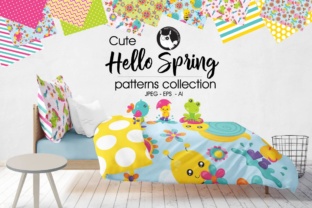
Hello Spring: Fresh, Playful Pattern Backgrounds for Real Creative Work
Imagine opening a design project and instantly landing on a background that feels like sunlight through new leaves—light, joyful, and quietly sophisticated. That’s the energy behind Hello Spring: a curated set of super cute, high-quality pattern background designs built for creators who need visual warmth without sacrificing professionalism.
It’s not just “spring-themed” in a cliché way—think pastel daisies or cartoon bunnies. Instead, Hello Spring delivers thoughtfully balanced repeats: delicate botanical motifs with subtle texture, soft geometric flourishes grounded in organic rhythm, and abstract watercolor washes that breathe like real spring air. Every pattern is designed to support—not overwhelm—the content layered on top.
Where These Patterns Actually Shine (Beyond the Obvious)
Designers often reach for pattern backgrounds when they want to add personality—but many settle for generic tiles or low-res downloads that pixelate at scale. Hello Spring solves that friction in practical, everyday scenarios:
- Small business branding kits: A boutique florist launching a new seasonal collection uses one of the floral-repeat patterns as the backdrop for her Instagram Story templates—clean enough for text overlays, charming enough to stop scrollers mid-feed.
- Educational printables: A homeschooling parent creates a “Spring Science Journal” for her kids. She drops a gentle leaf-and-raindrop pattern into Canva as a printable page background—soft contrast helps young eyes focus on hand-drawn diagrams without glare or visual fatigue.
- Wedding stationery: A freelance designer builds a suite for a garden ceremony—using the EPS vector file to scale the same pattern seamlessly across save-the-dates (letter-sized), menu cards (4×6”), and a large-format welcome sign—no quality loss, no extra editing time.
- Product packaging mockups: An indie candle maker previews her limited-edition “Lilac Mist” line using the Illustrator file (.ai) to recolor the background pattern to match her label palette—then exports clean JPEGs for her Shopify product gallery.
Who Gets the Most Out of Hello Spring—and Why
The beauty of Hello Spring isn’t just in its aesthetics—it’s in how flexibly it serves different working styles and goals.
Freelance designers appreciate having production-ready files that integrate smoothly into client workflows. The individual hi-res JPEGs (300 DPI) mean they can drop assets straight into print-ready PDFs or email-friendly PDFs without re-exporting. The vector files let them tweak spacing or isolate elements—say, pulling out a single blossom motif to use as a bullet point icon.
Content creators and educators love that nothing requires advanced software knowledge. If you’re comfortable dragging a JPEG into Google Slides or Keynote, you’re already equipped. No plugins, no subscriptions—just drag, resize, and go. One user shared how she used a muted mint-and-cream pattern as the base for her weekly newsletter header; subscribers told her it “felt like a breath of fresh air” compared to her old minimalist white template.
Small shop owners and makers benefit from the licensing clarity: these are for commercial use, meaning you can apply them to physical products (like printed greeting cards or fabric labels) or digital goods (like Canva templates you sell on Etsy)—no hidden restrictions or attribution strings.
What to Keep in Mind Before You Start Designing
While Hello Spring is intentionally versatile, real-world use means paying attention to context—not just color or cuteness.
Contrast matters more than charm. That dreamy lavender-and-sage pattern? Gorgeous on a mood board—but if you’re overlaying light gray body text on it, test readability at actual size. Many users find success by adding a subtle semi-transparent white overlay (10–15% opacity) over the pattern before placing text. It preserves the vibe while boosting legibility.
Scale shifts perception. A pattern that looks airy and open at 20% zoom may feel dense or busy when printed full-page. Try viewing your layout at 100% on screen *and* printing a small test swatch—especially if you’re designing for physical media like brochures or packaging.
Vector ≠ automatic simplicity. The EPS and .ai files give you full editability—but that also means responsibility. If you ungroup elements or adjust tile spacing in Illustrator, double-check that the repeat still aligns cleanly edge-to-edge. When in doubt, stick with the pre-built seamless tile (included in every format) for foolproof results.
Strengths That Solve Real Problems
What makes Hello Spring stand out isn’t novelty—it’s reliability wrapped in delight.
- No upscaling guesswork: Each JPEG arrives at true 300 DPI—so whether you’re designing a 24×36” poster or a 2×3” sticker sheet, resolution stays crisp.
- Format flexibility without compromise: Need to tweak colors? Open the .ai file. Need to place fast in PowerPoint? Use the JPEG. Preparing for offset printing? Rely on the EPS. All files contain the exact same composition—no version drift.
- Subtle sophistication over trend-chasing: These aren’t “viral” patterns designed for short-term appeal. They’re built with timeless spacing, restrained palettes, and intentional negative space—so they age well in brand systems and portfolios.
When to Pause and Consider Alternatives
Hello Spring excels when you want warmth, cohesion, and quiet confidence—not loud statements or hyper-specific themes. It’s less ideal if you need:
- Highly technical repeats (e.g., for textile manufacturing with strict repeat dimensions or bleed requirements—though the vector files can be adapted by an experienced production designer).
- Animated or interactive versions (these are static, print-and-web-ready assets only).
- Matching icon sets or full UI kits—this is a focused background collection, not a complete design system.
That said, many users layer Hello Spring alongside other trusted resources: pairing a pattern background with neutral stock photos, combining it with free Google Fonts for consistent typography, or using it as the foundation for custom letterpress invitations where tactile paper enhances the softness of the design.
Real Moments, Not Just Pixels
At its core, Hello Spring answers a quiet but persistent need: the desire to create something that feels human, intentional, and alive—without burning hours on custom illustration or hunting for royalty-free assets that lack soul.
It shows up in the teacher’s laminated classroom calendar, the therapist’s calming intake worksheet, the local coffee roaster’s seasonal menu board, and the wedding planner’s client presentation deck. It’s the kind of resource that doesn’t shout—but makes people pause, smile, and feel just a little more grounded in what they’re making.
If you’ve ever hesitated to add pattern because you worried it would look “too much,” “too childish,” or “too hard to get right”—Hello Spring was made for that moment. It’s permission to bring lightness into your work, backed by files that behave exactly as promised.