Christmas Baking Digital Paper Pack
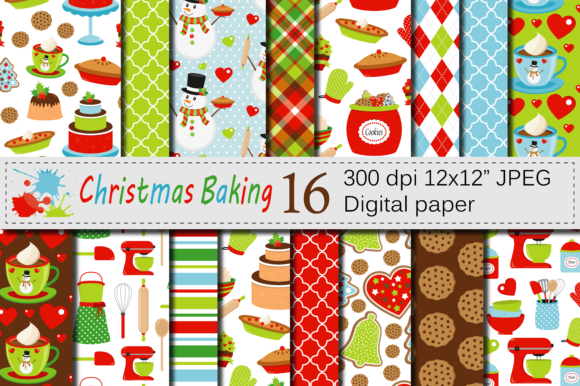
The Christmas Baking Digital Paper Pack is not just another seasonal design bundle—it’s a purpose-built creative asset for professionals and makers who value intentionality over ornamentation. At its core, it delivers 16 high-resolution (300dpi), 12×12 inch JPEG files—watermark-free, print-ready, and digitally versatile—featuring cohesive Christmas baking motifs: vintage-style kitchen utensils, frosted cakes, hand-iced cookies, whisk-and-rolling-pin silhouettes, and rustic flour-dusted textures—all rendered in a grounded palette of red, green, blue, and brown. That specific color balance matters: it avoids visual fatigue while supporting accessibility and brand alignment across formats.
Why This Pack Fits Strategic Creative Work—Not Just Decoration
When you’re designing a holiday product label, planning a limited-edition workshop kit, or building a cohesive social media campaign around seasonal baking, consistency isn’t aesthetic polish—it’s operational leverage. The Christmas Baking Digital Paper Pack supports that by offering a unified visual language *before* you begin layout work. Unlike sourcing individual clipart or piecing together mismatched elements, this pack reduces cognitive load during execution and strengthens message clarity for your audience. A small-batch cookie business launching a “Bake & Share” gift box can use the same paper motif across packaging inserts, email headers, and Instagram story templates—reinforcing recognition without repeating identical assets.
For educators creating printable holiday baking lesson plans—or freelancers designing client-facing holiday newsletters—the pack functions as a time-bound scaffolding tool. You’re not choosing colors or themes from scratch; you’re selecting from a curated, context-aware system. That shifts effort from ideation to implementation—freeing mental bandwidth for higher-stakes decisions like audience targeting, messaging tone, or call-to-action sequencing.
When to Use It—and When to Pause
The Christmas Baking Digital Paper Pack delivers maximum strategic value when aligned with clear objectives—not just calendar dates. Use it early in your planning cycle if you’re:
- Developing branded holiday merchandise (e.g., printable recipe cards, gift tags, or digital planner stickers) where visual cohesion signals professionalism;
- Building a seasonal content calendar and need reusable, on-brand backdrops for Canva-based graphics or printed flyers;
- Prototyping physical products (like custom notepads or wrapping paper) and require production-ready, bleed-safe 12×12 files;
- Teaching a holiday-themed design or food entrepreneurship workshop and want students to focus on composition and typography—not pixel hunting for festive elements.
Conversely, avoid deploying it reflexively—say, as filler in a generic holiday email blast or as background noise behind low-contrast text. Without thoughtful hierarchy or intentional contrast, even high-quality papers can dilute readability and weaken impact. Ask first: *Does this support the user’s next action—or just fill space?*
How to Approach It With Intention
Treat the Christmas Baking Digital Paper Pack as raw material—not a finished solution. Start by auditing your current assets: Do you already have a brand color palette? A consistent type system? A defined customer voice? If yes, test one or two papers against those anchors before committing to full-scale usage. Overlay your logo at actual size. Simulate print output using soft-proofing tools. Check how text renders over busy areas like cookie clusters or whisk patterns—some designs work better as borders or section dividers than full-page backgrounds.
Also consider scalability. While all 16 files are JPEGs (ideal for broad compatibility), they aren’t layered PSDs or vector files. That means you can’t easily recolor individual elements—but you *can* crop, rotate, tile, or blend them in ways that create variation without sacrificing cohesion. Try flipping a paper horizontally to generate a subtle alternate version, or use blending modes in Photoshop to mute intensity for delicate applications like wedding invitation liners.
Risks of Using It Without Context
The biggest risk isn’t technical—it’s strategic drift. Relying on the Christmas Baking Digital Paper Pack without clarifying your goal can lead to what designers call “thematic clutter”: visuals that feel festive but fail to communicate value, differentiate your offer, or guide attention. Imagine a bakery using the cake-patterned paper across every touchpoint—website banner, receipt tape, menu board—without adjusting contrast, scale, or placement. The result isn’t charm; it’s visual exhaustion and lost opportunity to highlight specials, sourcing stories, or delivery options.
Another underdiscussed risk is misalignment with audience expectations. A modern, minimalist pastry studio targeting Gen Z clients may find the warm brown-and-red palette too traditional unless deliberately juxtaposed with bold sans-serif type and ample negative space. Conversely, a heritage baking supply retailer might lean into those tones as authentic reinforcement—not decoration.
Practical Integration Across Roles
For entrepreneurs: Bundle select papers with digital product launches—e.g., include three coordinating backgrounds as bonus downloads with a holiday baking e-course. This increases perceived value without adding development overhead.
For marketers: Use one paper consistently as the base for all December social posts—then vary only headline font, CTA button color, and photo crop. That creates rhythm viewers subconsciously recognize, improving scroll-stop rate and brand recall.
For educators and publishers: Print select papers on cardstock for hands-on classroom activities—students can cut out utensil shapes to build “baking process” timelines or layer cookie motifs to visualize fractions. The tactile + visual pairing reinforces learning more effectively than flat worksheets alone.
For freelancers and agencies: Build a lightweight style guide around the pack for holiday projects—specify which papers work best for headers vs. footers, how much opacity to apply for text overlays, and which color combinations pass WCAG contrast thresholds. Reuse that guide across clients to maintain quality and accelerate scoping.
Long-Term Value Beyond the Season
Don’t assume the Christmas Baking Digital Paper Pack expires on January 1st. Its real longevity lies in adaptability—not expiration. Many of the textures (woodgrain countertops, parchment paper grain, matte ceramic glaze) translate seamlessly into non-holiday contexts: a “Spring Brunch” collection, a “Farm-to-Table Recipe Journal,” or even a “Kitchen Renovation Planner.” The red-and-green accents can be desaturated or masked with neutral overlays to become sophisticated background textures—not just festive signifiers.
More importantly, investing in a tightly curated, high-resolution pack like this builds your internal library of reliable assets—reducing future dependency on free-but-inconsistent resources or costly custom illustration. Over time, that consistency compounds: faster turnaround, stronger client trust, clearer creative boundaries, and fewer last-minute visual compromises.
Making the Decision That Scales
Before downloading or purchasing, ask yourself three questions:
- What specific outcome am I trying to achieve in the next 30–60 days? (e.g., “Launch a cohesive set of printable baking cards for Etsy” — not “Make things look Christmassy.”)
- Do I have the capacity to thoughtfully integrate these files—or will they sit unused because I haven’t blocked time for design iteration?
- Does this pack fill a gap in my current workflow—or duplicate assets I already own or license?
If the answer to all three is clear and affirmative, the Christmas Baking Digital Paper Pack becomes infrastructure—not inventory. It supports decisions instead of demanding them. And that’s how creative tools earn their place in serious work.