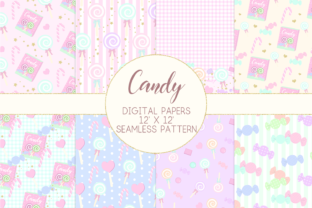
Candy Lollipop Digital Papers
Candy Lollipop Digital Papers is a curated set of eight high-resolution digital background papers designed for crafters, designers, and digital scrapbookers. Each paper measures 12 inches by 12 inches (3600 pixels × 3600 pixels), is saved in JPG format, and rendered at 300 dpi in the RGB color space. The patterns are seamless—meaning they can be tiled without visible breaks—making them suitable for repeated use across larger layouts or print projects.
This set emphasizes a playful, confectionery-inspired aesthetic: soft pastels, subtle candy motifs, and gentle textures that evoke lollipops, swirls, and sugary gradients. While visually cohesive, the collection avoids overly literal or juvenile interpretations—striking a balance between charm and versatility.
Who Might Consider Candy Lollipop Digital Papers?
Individuals evaluating Candy Lollipop Digital Papers typically fall into one of several overlapping groups: digital scrapbookers building themed pages (e.g., birthdays, baby showers, school events), graphic designers seeking lightweight, ready-to-use backgrounds for invitations or social media graphics, and small-business owners creating printable planners, labels, or product packaging mockups.
The appeal lies not only in the visual theme but in the technical specifications. At 300 dpi and 3600px square, each file supports high-quality printing on standard 12×12 scrapbook pages or full-sheet prints. The JPG format ensures broad compatibility—no specialized software is required to open or layer these files in common design tools like Photoshop, Canva, or Affinity Designer.
Key Benefits and Practical Advantages
One primary benefit is efficiency. Users avoid the time investment of creating custom seamless patterns from scratch. The included files are pre-tested for tiling behavior, reducing trial-and-error when designing repeating elements or large-format backgrounds.
Another advantage is consistency. Because all eight papers share a unified color palette and stylistic approach, combining them within a single project—such as a multi-page digital planner or a themed photo collage—requires minimal color correction or tone adjustment.
The RGB color space aligns with screen-based workflows, making these papers well-suited for web publishing, digital presentations, or social media templates. For users whose final output remains digital, this eliminates unnecessary conversion steps that could degrade color fidelity.
Important Considerations and Limitations
Color accuracy is a notable consideration. As noted in the product description, “color may vary depending on your computer screen.” This reflects the inherent variability of RGB displays—calibrated monitors will render hues more faithfully than uncalibrated laptops or mobile devices. Users intending to match these papers to physical printed materials (e.g., coordinating stationery) should treat on-screen previews as directional rather than definitive.
JPG format introduces tradeoffs. While widely supported and relatively small in file size, JPG does not support transparency. If a project requires overlays, cut-out elements, or layered blending modes where background visibility matters, users will need to manually mask or place these papers behind other elements—unlike PNG files with alpha channels.
The set contains exactly eight papers, with no variations in scale, rotation, or recoloring included. Users needing greater flexibility—such as alternate light/dark versions, monochrome variants, or pattern density adjustments—will need to edit the files themselves or seek supplemental resources.
Situations Where Candy Lollipop Digital Papers Is a Strong Fit
This set works especially well for time-constrained creators who prioritize thematic cohesion over maximal customization. For example, someone assembling a birthday-themed digital scrapbook kit for resale on platforms like Etsy may find the consistent candy motif and print-ready resolution ideal for generating cohesive product previews and downloadable assets.
It also suits educators or activity designers developing printable worksheets or reward charts where visual appeal supports engagement—particularly for younger audiences—without requiring photorealistic detail or complex licensing terms.
Because the patterns are subtle rather than dominant, these papers function effectively as understated backdrops. They provide texture and warmth without competing with foreground text or photos, making them appropriate for newsletters, blog banners, or presentation slides where clarity remains paramount.
When Alternatives May Be Worth Exploring
Users whose work demands precise color matching—especially for brand-aligned marketing materials—may prefer digital papers delivered in CMYK or with embedded ICC profiles. Similarly, designers frequently incorporating transparent layers or non-rectangular masks may find PNG-based collections more adaptable despite larger file sizes.
If the lollipop theme feels too narrow for long-term use, broader pattern libraries—such as those organized by texture (linen, marble, watercolor), style (vintage, modern, minimalist), or function (grids, frames, borders)—offer greater reuse potential across diverse projects.
For those needing scalability beyond 12×12 inches—or working with vector-based tools—vector pattern swatches (e.g., SVG or AI files) allow infinite resizing without quality loss. While Candy Lollipop Digital Papers delivers excellent raster fidelity at its stated dimensions, it does not support enlargement beyond 3600px without interpolation artifacts.
Making an Informed Decision
Evaluating Candy Lollipop Digital Papers comes down to alignment between its fixed attributes and your specific workflow requirements. Ask yourself:
- Is the visual theme appropriate for my current or upcoming projects? If you’re building multiple items around celebration, sweetness, or youth-oriented design, the motif adds value. If your needs span formal, technical, or neutral contexts, the theme may limit utility.
- Do I primarily work in RGB and output digitally? Then the color space and JPG format present few obstacles. If your process includes frequent CMYK conversion or transparency-dependent compositing, consider whether additional editing time offsets the convenience.
- How important is out-of-the-box readiness versus long-term adaptability? Eight carefully matched papers offer immediate usability; however, they represent a fixed scope. Compare this against subscription-based libraries or modular pattern packs if your needs evolve across themes or formats.
Finally, assess your tolerance for minor color variance. If screen-to-print consistency is critical—and you lack hardware calibration tools—requesting a test print sample before committing to larger projects is a prudent step.
In summary, Candy Lollipop Digital Papers serves a defined niche: creators who value thematic unity, print-ready resolution, and seamless tiling within a friendly, accessible format. It is neither a universal solution nor a substitute for fully customizable design assets—but for its intended use cases, it provides measurable practical benefits without unnecessary complexity.