Mandala Pattern Scrapbook Papers
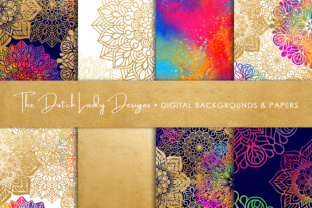
Richly symmetrical, deeply calming, and endlessly adaptable—Mandala Pattern Scrapbook Papers bring intentional design into your creative workflow. This set isn’t just decorative; it’s a precision-crafted toolkit for makers who value both aesthetic harmony and technical reliability. With eight distinct JPEG files—each 3600×3600 pixels at 300 DPI—you get true 12×12 inch print-ready canvases that retain crisp detail whether scaled down for digital cards or printed full-size on premium cardstock.
Why symmetry matters in real-world design
Mandalas carry visual weight: their radial balance guides the eye, creates focal calm, and subtly reinforces messages of unity or intention. That’s why educators use mandala backgrounds in presentation slides to reduce cognitive load during workshops; why wellness coaches embed them into client workbooks to support mindful reflection; and why small business owners choose them for branded email headers—to signal thoughtfulness without saying a word. Unlike generic geometric repeats, these patterns are built with layered motifs and organic spacing, giving each paper breathing room and character. You’re not adding “more decoration”—you’re anchoring your content in visual coherence.
Designed for flexibility—not just aesthetics
Each file is delivered as a high-resolution JPEG, ensuring compatibility across platforms and software. No layers, no PSD dependencies—just clean, ready-to-place assets. That means if you’re using Canva for social media graphics, Affinity Designer for print layouts, or even PowerPoint for classroom handouts, you can drag, resize, and overlay text confidently. The 300 DPI resolution guarantees sharp output whether you’re printing a 5×7 invitation or a 24×36 wall display—and because all files are square (3600×3600), cropping for non-square formats (like Instagram posts or blog banners) becomes intuitive, not frustrating.
Where these papers solve actual problems
Consider a freelance graphic designer preparing a brand kit for a yoga studio. They need cohesive, on-brand backgrounds for digital classes, printable PDFs, and social tiles—all within tight deadlines. Instead of building patterns from scratch or licensing low-res stock, they drop in one of these mandala papers as a base layer, adjust opacity or hue via adjustment layers, and export variants in under five minutes. Or imagine a homeschool parent assembling a digital photo album for their child’s science project: the mandala background adds quiet sophistication without competing with labeled diagrams or handwritten notes. It doesn’t shout—it supports.
Bloggers and content creators also benefit meaningfully. A clean mandala paper used as a subtle website background (with appropriate contrast for text legibility) conveys warmth and intentionality—especially effective for niches like mindfulness, education, or holistic health. Because the files are JPEGs—not tiled repeats—you avoid visible seams when stretched across wide monitors or mobile viewports. And since each pattern is unique, you can assign specific papers to different content categories: one for resource pages, another for newsletter headers, a third for downloadable checklists—creating visual rhythm across your site without repetitive branding.
Who gains the most—and how to use them well
This set serves creators who already own and regularly use image editing software—whether Adobe Photoshop, GIMP, Photopea, or Affinity Photo. That’s not a limitation; it’s clarity. These aren’t “plug-and-play” templates with locked elements. They’re foundational assets meant to be edited: recolored to match brand palettes, masked to reveal photos beneath, blended with textures, or cropped to highlight specific motifs. If you’re comfortable adjusting brightness, applying layer masks, or saving for web/print, you’ll integrate these papers seamlessly.
That said, if you’re new to editing software—or rely solely on drag-and-drop tools like Cricut Design Space or basic Canva plans—some adaptation will be needed. You won’t be able to recolor or layer these files without exporting edits first. In those cases, treat them as high-fidelity starting points: import, resize, add text or shapes directly over them, and export final compositions. For deeper customization, consider pairing this set with beginner-friendly tutorials on blending modes or non-destructive color adjustments—skills that pay dividends far beyond this single purchase.
Practical tips for getting consistent results
- Always check color mode: For professional printing, ensure your document is in CMYK before sending to a print service—even though the JPEGs are RGB by default. Most editing software lets you convert without quality loss at export.
- Respect resolution boundaries: While these files scale beautifully downward, avoid enlarging beyond 150% of original size in print layouts. At 300 DPI, they’re optimized for 12×12 inches—but halving dimensions (to 6×6”) still yields 600 DPI output, ideal for fine-detail projects like greeting card inserts.
- Test contrast early: Mandala patterns contain fine lines and tonal gradients. Before laying light text over a busy motif, try a semi-transparent white or black overlay (10–15% opacity) to boost readability without obscuring the design.
- Use them as texture sources: Import a mandala paper into your software, desaturate it, apply Gaussian blur, and set blend mode to “Overlay” or “Soft Light” over solid-color layers. Instant depth—no extra assets required.
A note on fit and intention
Mandala Pattern Scrapbook Papers won’t replace complex layout templates or interactive design systems. They’re not meant for animated web elements or responsive CSS backgrounds (where SVG or CSS-generated patterns offer more control). But where you need beautiful, printable, editable, and emotionally resonant surface design—these deliver quietly and reliably. They suit projects where craft meets clarity: handmade greeting cards with hand-lettered messages, educator-created worksheets that feel inviting rather than clinical, or digital planners designed to reduce visual fatigue.
They also pair well with other tactile or analog workflows. Print one at 12×12 inches on matte cardstock, cut it into custom journal covers, or use it as a base for mixed-media collages. Because the resolution holds up, scanning your finished physical piece back into digital form preserves fidelity—making this set valuable across hybrid creative processes.
Final thought: Tools reflect values
Choosing a mandala-based design asset isn’t just about visual preference—it’s an alignment with intentionality, balance, and care in communication. Whether you’re designing a client’s product launch deck or assembling a memory book for a loved one, these papers offer quiet confidence: no guesswork on resolution, no licensing ambiguity, no pixelation at print size. They’re built for people who make things—thoughtfully, repeatedly, and with respect for both process and outcome.