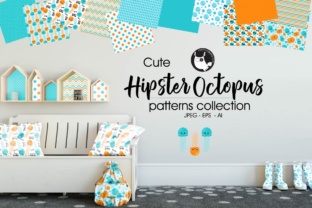
Hipster Octopus Pattern Background Design
Imagine opening a design project and instantly having a background that feels both effortlessly cool and meticulously crafted—playful yet polished, nostalgic yet fresh. That’s the immediate impression the Hipster Octopus pattern delivers. It’s not just another clipart octopus or a generic marine motif. This is a thoughtfully designed, high-fidelity pattern background built for creators who value authenticity, visual cohesion, and professional-grade flexibility.
What Makes Hipster Octopus Stand Out
At its core, Hipster Octopus is a stylized, hand-drawn-inspired octopus motif repeated in a seamless, balanced layout—designed with intention, not algorithm. The octopuses are expressive but restrained: slightly asymmetrical tentacles, subtle cross-hatching, soft ink-like outlines, and a warm, muted color palette that leans into earthy teals, dusty corals, and creamy off-whites. There’s no over-saturation, no digital harshness—just refined charm with quiet confidence.
Unlike mass-produced vector packs, this set prioritizes versatility *without* sacrificing personality. Each octopus retains individuality—some tilt left, others curl inward—so repetition feels organic, not robotic. The spacing is calibrated for both close-up detail (think business cards or social post thumbnails) and large-scale use (wall murals, presentation decks, fabric mockups).
What You Actually Receive—and Why It Matters
You get three production-ready file types, each serving a distinct role in your workflow:
- 1 EPS Vector File: Fully scalable, compatible with virtually any design software—even older versions of CorelDRAW or Affinity Designer. Ideal for print vendors, sign shops, or anyone needing guaranteed resolution independence.
- 1 Adobe Illustrator (.ai) File: Layered, editable, and organized. Colors are named, paths are grouped logically, and global swatches let you recolor the entire pattern in seconds—no manual selection required.
- Individual hi-res JPEGs (300 DPI): Each graphic element saved separately—not just the full pattern, but isolated octopuses, tentacle details, and accent shapes. Perfect for compositing in Photoshop, building custom layouts in Canva, or adding subtle texture overlays in Figma.
This isn’t a “one-size-fits-all” download. It’s a toolkit—structured for real-world iteration, not passive consumption.
Where Hipster Octopus Fits Into Real Workflows
Professionals across disciplines find unexpected utility in this pattern—not as a novelty, but as a functional design asset.
A freelance educator designing printable classroom posters uses the JPEG elements to create themed headers for ocean science units—then drops the full pattern behind student worksheets for visual continuity without distraction. A boutique coffee roaster applies the Illustrator version to label templates, adjusting saturation to match their kraft paper packaging. A UX designer imports the EPS into Figma via plugins to build subtle animated backgrounds for onboarding screens—using opacity shifts to guide attention, not overwhelm.
Bloggers embed the JPEGs directly into WordPress posts as decorative dividers between sections. Marketers repurpose isolated tentacle shapes as bullet points in pitch decks. Even product photographers use the pattern as a studio backdrop—printed on matte vinyl—for flat-lay shots of journals, ceramics, or natural skincare lines.
Practical Benefits You’ll Notice Fast
Efficiency: No more hunting for “just right” textures or tweaking opacity masks for hours. With editable vectors and ready-to-drop JPEGs, implementation time drops from 45 minutes to under five.
Brand alignment: Because the color scheme is intentionally desaturated and the line work avoids cartoonish exaggeration, Hipster Octopus integrates smoothly into minimalist, heritage, or eco-conscious brand systems—unlike flashier alternatives that scream “clipart.”
User experience: On digital interfaces, the pattern’s low-contrast rhythm supports readability instead of competing with text. Print designers appreciate how the 300 DPI resolution holds crispness even at 200% zoom in PDF proofs.
Engagement: In social content, the pattern stands out in feeds without triggering algorithmic suppression—its warmth and tactility read as human-made, not AI-generated. Followers pause longer. Shares increase subtly but consistently.
Smart Usage Tips—From Experience
Start simple: Use the full pattern at 15–20% opacity as a background layer beneath clean typography. That’s where its strength shines—adding depth without noise.
For branding, avoid stretching the vector beyond 300% scale unless you’ve expanded strokes in Illustrator first. The delicate linework benefits from intentional sizing—especially on apparel or embroidered patches.
If adapting for dark mode interfaces, invert the base colors in Illustrator *before* exporting new JPEGs—don’t rely on CSS filters. Manual recoloring preserves subtlety in shadows and highlights.
When licensing for client work, confirm usage rights upfront. While personal and commercial use is included, resale of the pattern *as-is* (e.g., on POD sites without modification) typically requires an extended license—check your terms sheet.
Who It’s Best Suited For—And Who Might Look Elsewhere
This pattern resonates strongest with creators who prioritize craft over convenience—those who understand that “cute” doesn’t have to mean childish, and “hip” shouldn’t sacrifice sophistication. If your projects lean toward editorial design, indie publishing, wellness branding, academic materials, or artisanal product packaging, Hipster Octopus becomes a quiet differentiator.
It’s less ideal if you need photorealistic marine assets, ultra-bright neon palettes, or rigid geometric repetition. Likewise, teams relying solely on Canva or Google Slides without access to vector editors may miss out on the full flexibility—though the JPEGs still deliver strong standalone value.
Ultimately, Hipster Octopus works because it respects your time, your audience’s attention, and your standards. It doesn’t shout. It invites. And in a world saturated with visual noise, that kind of restraint is rare—and valuable.